NewsPersonality Profile
Olu Of Warri Urges Niger Deltans To Unite, Lead In Harnessing Opportunities Of Emerging Blue Economy

Ogheneruona Tejiri, Warri
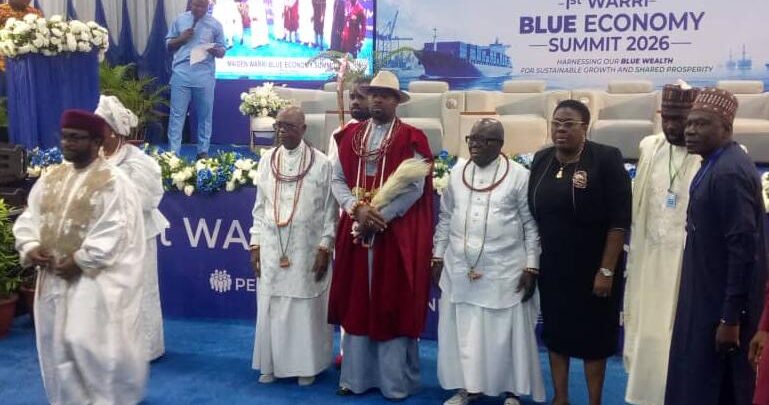
Ogiame Atuwatse 111, Olu of Warri has called on people of the Niger Delta to unite and take the lead in harnessing the opportunities of the emerging blue economy.
The Olu made this call at the maiden Warri Blue Economy Summit (WABES) 2026 in Warri, Delta State, he emphasized that while harnessing the opportunities therein, the environment should be protected and there should also be meaningful local participation in its benefits.
The monarch said that the region must not repeat the mistakes associated with previous resource booms, but instead build a development model that balances economic growth with environmental sustainability.
According to him, “too many times, Warri and the greater Niger Delta have missed the opportunity to be a pioneer, a leader and a strong beneficiary of what God has blessed us with. I believe God has given us another opportunity and it is time for us to rise to that occasion and be the ones leading the charge”.
The Olu described blue economy as a new frontier capable of transforming the region’s productive potential, but he cautioned against pursuing economic gains at the expense of the environment.
Ogiame Atuwatse 111 added, “I am not just the custodian of the people and culture, but also the custodian of the environment itself. While we want our lives to drastically improve by the proceeds of the blue economy, our environment must not pay the price”.
While calling for a “new blueprint for responsible capitalism,” Ogiame Atuwatse 111 stressed that communities must enjoy the full benefits of development within the Niger Delta rather than being forced to migrate to urban centres in search of opportunities.
The Olu spoke further, “this time the people must witness a positive impact of the full formation of this economy, not just in their pocket, but in their environment and in their lives, without them having to relocate away from this environment and run to urban areas”.
The monarch also highlighted the economic and environmental value of the Niger Delta’s mangrove forests, he advocated for the protection of the mangrove through participation in global carbon credit markets.
He once more added, “our mangrove forests are among the most effective natural carbon sinks. By formally protecting and managing these habitats, we can generate high-quality carbon credits. The sale of these credits can provide reliable income streams, support local communities, create conservation jobs and fund development projects while safeguarding the environment.
“Our vision extends far beyond conservation. It is about building a thriving green economy that works hand-in-hand with the blue economy and the orange economy, while benefiting those of us who are here now and the generations to come.”
In his speech, Adeg O’tega Oyetola, Minister of Marine and Blue Economy represented by Irene Imade Ideva and Mrs. Alice Onoriode, Director of Legal Services and Assistant Director respectively of the Ministry said that the summit’s theme, “Harnessing Our Blue Wealth for Sustainable Growth and Shared Prosperity,” aligned with President Bola Tinubu’s Renewed Hope Agenda and the Federal Government’s strategy for economic diversification.
The Minister said that Nigeria possesses the natural endowments required to emerge as Africa’s leading blue economy destination, citing its extensive coastline, inland waterways, abundant aquatic resources and strategic location on international shipping routes.
Oyetola said that opportunities abound in maritime transport, fisheries, aquaculture, shipping, logistics, offshore services, coastal infrastructure and marine tourism, he stressed that public-private partnerships would be critical to unlocking investments across the sector.
Oyetola identified Warri as a key maritime and industrial hub whose growth would remain central to Nigeria’s maritime future, he underscored the need for environmental stewardship, climate resilience, community participation and youth skills development.
In her presentation, Hannatu Musawa, Minister of Arts, Culture, Tourism and Creative Economy called on stakeholders to broaden the concept of the blue economy beyond shipping and fisheries to include culture, tourism and the creative industries.
Represented by Dr. Kabir Musanawa, Technical Adviser to the Minister said that Nigeria’s coastlines, waterways, mangrove ecosystems, festivals, traditional institutions and indigenous knowledge systems are economic assets capable of attracting global investment and creating sustainable livelihoods.
According to Musawa, “Warri is not only an economic hub; it is a cultural gateway where history, trade, tradition and innovation have coexisted for centuries”.
The Minister outlined opportunities in riverine tourism circuits, maritime cultural festivals, museums, heritage centres, cruise tourism, eco-tourism and creative content inspired by Nigeria’s maritime history, she noted that the Summit advanced several United Nations Sustainable Development Goals, including poverty reduction, decent work, climate action and life below water.
Earlier, in her welcome address, Chief Ebiyemi Omatseye, Executive Chairman, Warri Blue Economy Development Initiative disclosed that the summit marked a defining moment in the economic and developmental journey of Warri Kingdom.
Dame Omatseye said that the blue economy offered a pathway to long-term prosperity through sectors such as shipping, ports, tourism, aquaculture, renewable energy, environmental conservation and coastal infrastructure, while addressing unemployment, environmental degradation and limited economic opportunities in local communities.
According to her, “our waterways must become pathways to prosperity and our resources catalysts for development”.
Former Director-General of the Nigerian Maritime Administration and Safety Agency (NIMASA), Dr. Temisan Omatseye, who spoke on the legal framework and opportunities within the blue economy, identified agriculture, solid minerals, natural gas and human capital development as key pathways out of Nigeria’s economic challenges.
He argued that the Warri Port should be developed beyond being a feeder port, citing marine logistics constraints, particularly the Escravos Bar, which limits the size of vessels that can access the area.
Also speaking, Augusta Anyanwu-Egbom, Regional Head Fidelity Bank Plc said that the blue economy had the potential to generate more than 40 million jobs in Nigeria if properly developed.
She called for stronger partnerships involving development finance institutions, the World Bank, development partners and agencies implementing the Sustainable Development Goals to unlock investment opportunities across the sector.
She said that investors stand to benefit from at least 10 strategic segments of the blue economy, including ports and logistics, marine transport, fisheries and aquaculture, coastal tourism, offshore services, renewable energy and related investment ecosystems.
Panel discussions and technical sessions at the summit examined entrepreneurship and capacity building in the maritime industry, harnessing water-based tourism for economic empowerment and growth, the impact and opportunities of the Koko Free Trade Zone, diversification beyond oil and gas, and tourism as a catalyst for inclusive growth and community integration.
The three day summit called for stronger collaboration among government, traditional institutions, investors, development partners and local communities to ensure that the Niger Delta becomes a leading beneficiary of Nigeria’s emerging blue economy, while preserving its fragile ecosystems for future generations.