From Francis Sadhere, Delta
Women in Chemistry (WIC) have called on the Niger Delta Development Commission (NDDC) and the North East Development Commission (NEDC) to urgently intervene in what they described as the worsening state of science laboratories in public secondary schools across the country.
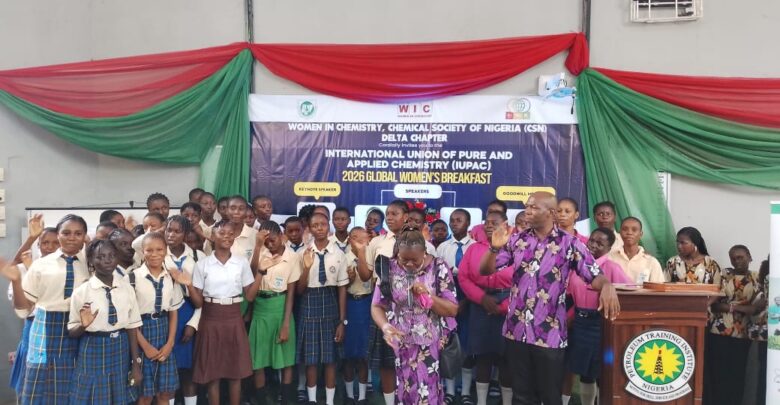
The call was made on Tuesday, February 10, 2026, during the International Union of Pure and Applied Chemistry (IUPAC) 2026 Global Women’s Breakfast, held at the Petroleum Training Institute (PTI), Effurun, Delta State.
Speaking at the event, which brought together scientists from different parts of the world under the theme “Many Voices, One Science,” the outgoing Coordinator of WIC, Dr. Sarah Nwinee, lamented that the absence of functional laboratories in many state-owned schools was discouraging students—especially young girls—from pursuing careers in science, technology, engineering and mathematics (STEM).
Dr. Nwinee noted that meaningful chemistry education could not be achieved through theory alone, stressing that the lack of practical exposure had weakened students’ interest and performance in the subject.
She urged intervention agencies and other relevant stakeholders to prioritise education by equipping schools with standard laboratories, describing such investment as critical to national development.
She said the annual Global Women’s Breakfast, coordinated in Nigeria by the Chemical Society of Nigeria (CSN), had over the years served as a platform for advocacy, mentorship and collaboration aimed at promoting the participation of women in science.
According to her, the 2026 edition was particularly significant as it reflected years of sustained engagement, partnerships and increased support for programmes targeting young scientists.
Chairman of the CSN Delta Chapter, Professor Ellas Elemike, also stressed the need for deliberate efforts to nurture the next generation of scientists, noting that sustainability in the profession depended on inspiring and properly training younger minds.
He highlighted the Society’s “Train the Trainer” initiative, which is focused on improving science teaching methods and making science more relatable and practical for students.
The issue of gender disparity in science was also highlighted at the event. A former Deputy Vice-Chancellor and facilitator of the programme, Professor Doris Ogeleka, decried persistent gender bias against women in scientific careers. She called for greater confidence, assertiveness and inclusiveness to ensure that women’s contributions in science are recognised and valued.
As part of activities marking the event, a chemistry quiz competition was organised for secondary schools in the area. The College of Education Demonstration Secondary School emerged winner, clinching the top prize of ₦250,000. The winners, Ezimadu Emmanuella and Chukwuka Ngozi Favour, said the competition had increased their interest in chemistry and strengthened their preparation for external examinations.
Participants at the event agreed that without urgent and sustained investment in practical science education, Nigeria risks undermining the development of future chemists, innovators and researchers, particularly women, whose participation remains crucial to the nation’s scientific and technological advancement.
Women in Chemistry (WIC) have called on the Niger Delta Development Commission (NDDC) and the North East Development Commission (NEDC) to urgently intervene in what they described as the worsening state of science laboratories in public secondary schools across the country.
The call was made on Tuesday, February 10, 2026, during the International Union of Pure and Applied Chemistry (IUPAC) 2026 Global Women’s Breakfast, held at the Petroleum Training Institute (PTI), Effurun, Delta State.
Speaking at the event, which brought together scientists from different parts of the world under the theme “Many Voices, One Science,” the outgoing Coordinator of WIC, Dr. Sarah Nwinee, lamented that the absence of functional laboratories in many state-owned schools was discouraging students—especially young girls—from pursuing careers in science, technology, engineering and mathematics (STEM).
Dr. Nwinee noted that meaningful chemistry education could not be achieved through theory alone, stressing that the lack of practical exposure had weakened students’ interest and performance in the subject.
She urged intervention agencies and other relevant stakeholders to prioritise education by equipping schools with standard laboratories, describing such investment as critical to national development.
She said the annual Global Women’s Breakfast, coordinated in Nigeria by the Chemical Society of Nigeria (CSN), had over the years served as a platform for advocacy, mentorship and collaboration aimed at promoting the participation of women in science.
According to her, the 2026 edition was particularly significant as it reflected years of sustained engagement, partnerships and increased support for programmes targeting young scientists.
Chairman of the CSN Delta Chapter, Professor Ellas Elemike, also stressed the need for deliberate efforts to nurture the next generation of scientists, noting that sustainability in the profession depended on inspiring and properly training younger minds.
He highlighted the Society’s “Train the Trainer” initiative, which is focused on improving science teaching methods and making science more relatable and practical for students.
The issue of gender disparity in science was also highlighted at the event. A former Deputy Vice-Chancellor and facilitator of the programme, Professor Doris Ogeleka, decried persistent gender bias against women in scientific careers. She called for greater confidence, assertiveness and inclusiveness to ensure that women’s contributions in science are recognised and valued.
As part of activities marking the event, a chemistry quiz competition was organised for secondary schools in the area. The College of Education Demonstration Secondary School emerged winner, clinching the top prize of ₦250,000. The winners, Ezimadu Emmanuella and Chukwuka Ngozi Favour, said the competition had increased their interest in chemistry and strengthened their preparation for external examinations.
Participants at the event agreed that without urgent and sustained investment in practical science education, Nigeria risks undermining the development of future chemists, innovators and researchers, particularly women, whose participation remains crucial to the nation’s scientific and technological advancement.