By Francis Sadhere, Warri
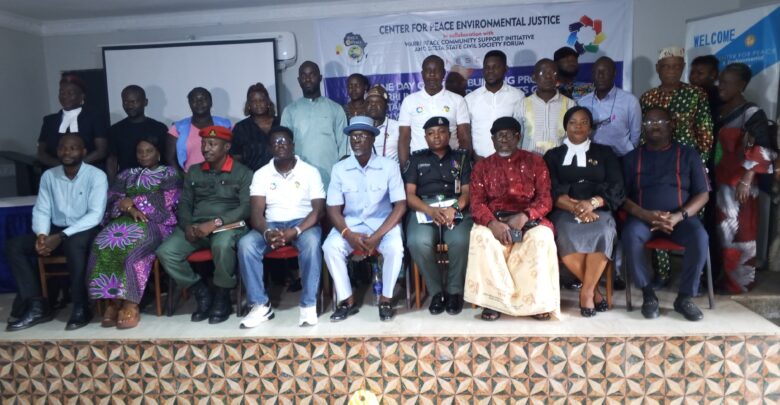
Stakeholders from across Warri Federal Constituency have been equipped with practical skills in conflict management and early warning systems following a one-day capacity building programme held in Warri, Delta State.
The training, organized by the Center for Peace Environmental Justice in collaboration with the Warri Peace Community Support Initiative and the Delta State Civil Society Forum, brought together members of the Warri Indigene and Residents Committee alongside other key stakeholders.
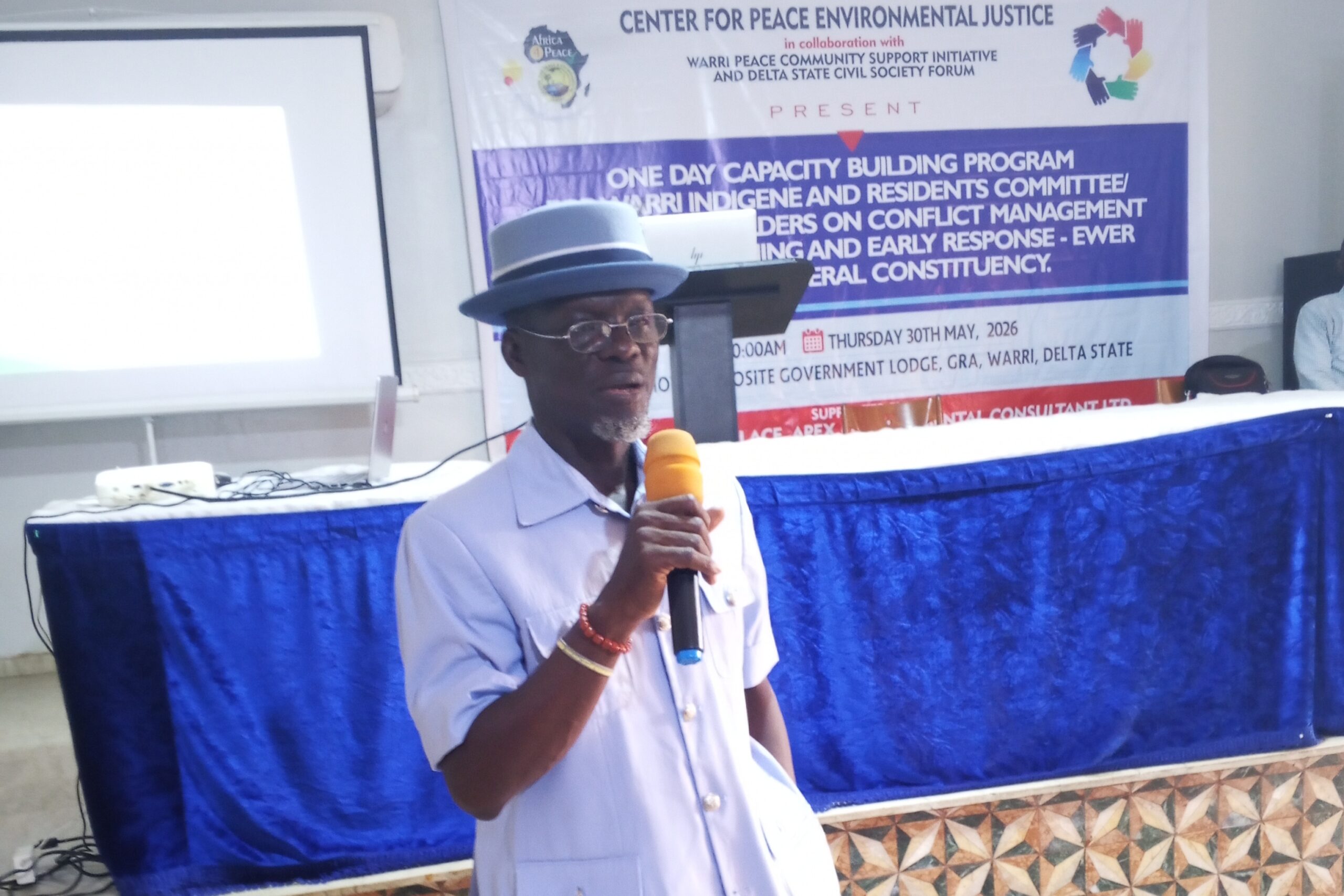
The event, which held at Peemos Hotel, featured expert-led sessions focused on strengthening community resilience, preventing conflict, and improving response mechanisms.
Delivering a presentation on “The Economic Impact of Conflict: A Focus on Family,” Mrs. Martha Onose, Executive Director of Community Empowerments and Development Initiative (CEDI), emphasized that conflict is never a viable solution, noting that it often leads to reversed development and economic displacement.
She highlighted the immediate economic shocks faced by families during conflicts, including destruction of assets, loss of income, and increased household expenses. She added that many youths involved in conflicts often lack a clear understanding of the cause.
Mrs. Onose further outlined the long-term effects of conflict on families, such as increased burden on women, disruption of children’s education, and the cost of displacement. She explained that households often adopt coping mechanisms like asset liquidation and cutting down consumption to survive.
Proffering solutions, she advocated early mediation and youth protection, urging communities to leverage local leaders and traditional rulers in resolving disputes, while also calling on women to guide and monitor their children.
She warned that conflict breaks down family units and leaves lasting economic scars, stressing that targeted, family-focused support is essential for recovery. “Hunger does not choose which family to attack,” she said.
In another session, Mr. Fater Kyegh, an Early Warning and Early Response (EWER) Analyst under a European Union-supported project, spoke on “Early Warning and Early Response System.”
He described conflict early warning as an alert mechanism—signals or advance notice indicating potential conflict, disasters, or famine—while early response refers to prompt actions taken once threats are identified.
Mr. Kyegh outlined three levels of response: policy-level interventions involving decision-making, operational actions such as mediation and negotiation, and advocacy through public awareness campaigns using platforms like radio and social media.
Participants were also introduced to the concept of a conflict early warning system, designed to help communities detect risks early and prevent escalation.
In his closing remarks, Coordinator of the Center for Peace Environmental Justice, Sheriff Mulade, said the Warri Indigene and Residents Peace Building Committee was established a few months ago to de-escalate tensions in Warri following the ward delineation exercise crisis.
According to him, the period witnessed heightened anxiety across communities, prompting coordinated efforts by government, stakeholders, and residents to restore calm.
“Within that period, there was tension in Warri, but stakeholders came together to ensure peace. In our own little way, we have been able to sustain that peace and create the necessary impact required,” he said.
He noted that the capacity building programme was designed to further educate committee members and relevant stakeholders, emphasizing that peacebuilding is a collective responsibility.
“We are all stakeholders, and the peace we need in Warri cannot be provided by government alone or security agencies alone. It must be provided by all of us,” he added.
Mulade stressed what he described as the “three capital C’s” necessary for sustaining peace in Warri—communication, cooperation, and coexistence.
“We must communicate and engage in dialogue at all times. Without cooperation, there can be no lasting peace. And most importantly, we must coexist,” he said.
He stressed that the major ethnic groups in Warri—the Itsekiri, Ijaw, and Urhobo—must embrace peaceful coexistence, noting that no amount of violence can eliminate or displace any group.
“God has placed these groups together in Warri. No crisis can drive any of them away. What we need is to work together for development and sustained peace,” he stated.
The committee, he explained, also works closely with security agencies, commending their efforts in maintaining law and order.
“If the police are not on the roads, movement will be difficult and insecurity will rise. While they may have shortcomings, they remain essential to maintaining order,” he said.
He added that the engagement of experts at the programme was to provide practical insights and strengthen collaboration among stakeholders, residents, and security agencies in preventing and responding to conflicts.
The programme received support from DPG, K&Q Food Palace, and Apex Environmental Consultant Ltd.
Participants expressed confidence that the knowledge gained would enhance their ability to detect early warning signs and respond effectively, thereby fostering sustainable peace in their communities.